


DATA for GOOD FOUNDATION
Build Trust and Innovation
When data is used responsibly and intelligently, it helps public institutions deliver better services, strengthen public trust, and use resources more effectively.
Gain deeper insight into citizens’ needs and behaviour by accessing relevant data.
Securely connect new and existing data sources — internal and external — under clear governance.
Protect your institution with a secure, neutral platform built on strong governance principles — designed to reduce data-leak risk and support GDPR-aligned use.
Give citizens full transparency and control over the data they have consented to provide.
Integrate DATA for GOOD and consent workflows into existing public-sector systems and partner environments.
DATA for GOOD Governance Tools
Embedding governance directly into operational data use
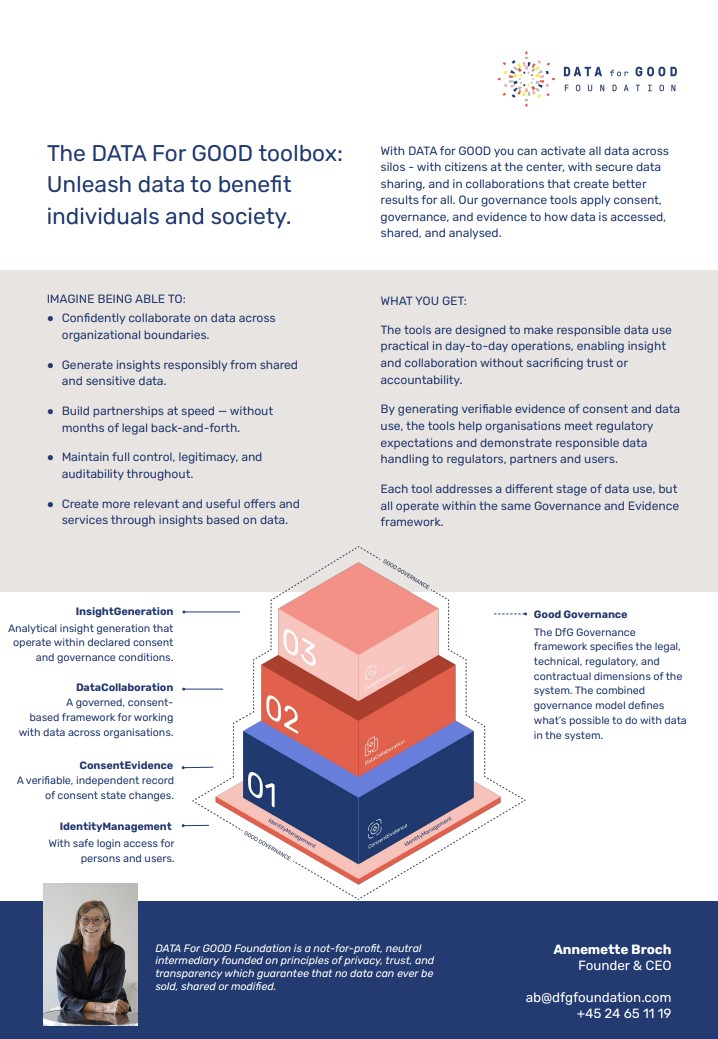
DATA for GOOD Governance Tools apply consent, governance, and evidence directly in how data is accessed, shared, and analysed. They are designed to make responsible data use practical in day-to-day operations, enabling insight and collaboration without sacrificing trust or accountability.
Rooted in DfG’s BLTSEC principles — Business, Legal, Tech, Society, Ethics, and Culture — the tools ensure that governance considerations are embedded across organisational, regulatory, and technical dimensions from the outset. Rather than treating governance as a compliance afterthought, DfG operationalises it as a shared, inspectable infrastructure.
Governance in Practice
DfG’s Governance Spine provides the operational structure that connects declared scope, aligned responsibilities, and verifiable evidence across the lifecycle of a data use case. It ensures that governance expectations are defined before activation, remain consistent during operation, and are inspectable over time.
Rather than relying on policy statements alone, the Spine embeds governance directly into onboarding, collaboration, and change management. It creates a shared accountability reference point that supports transparency, regulatory engagement, and coordinated ecosystem participation.
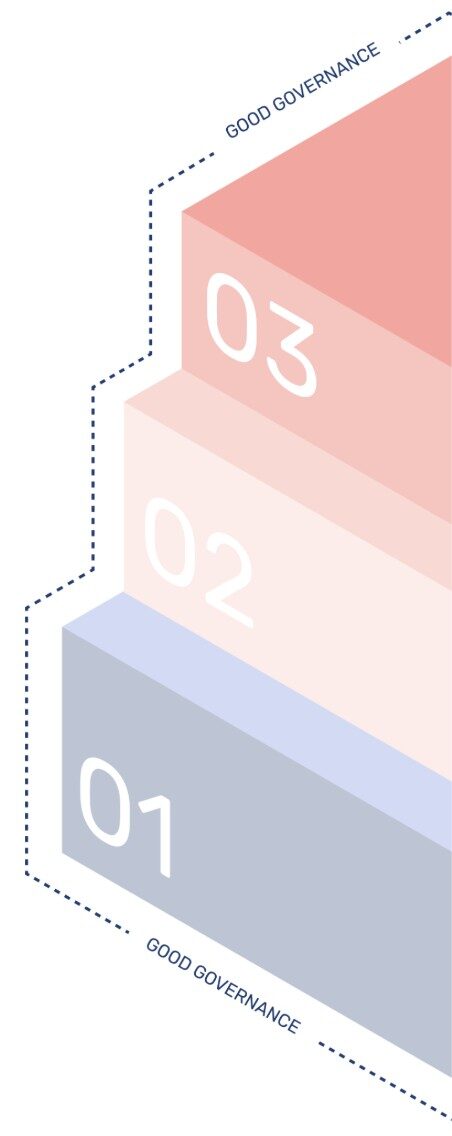
The Three-Layer Governance Stack
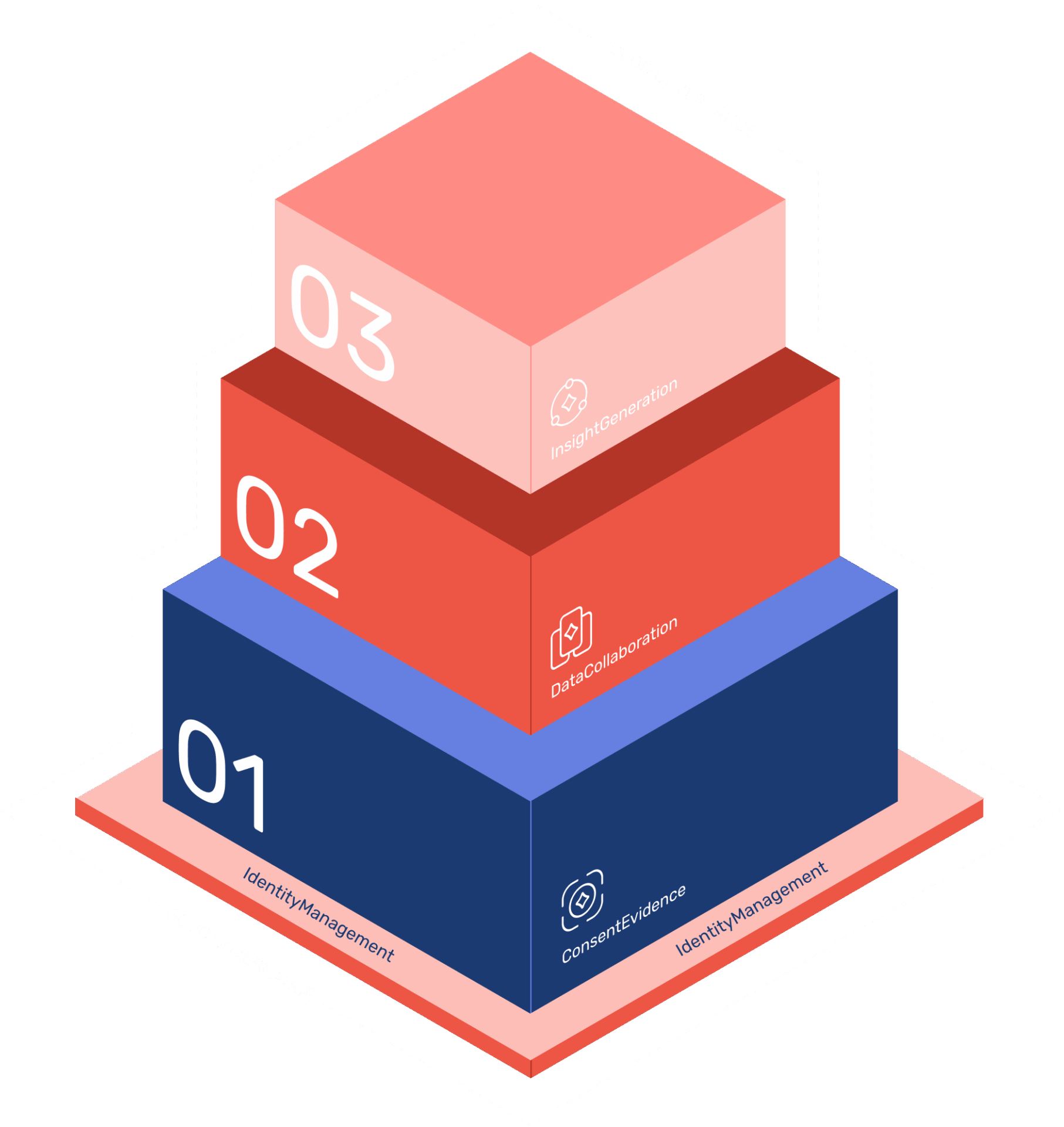
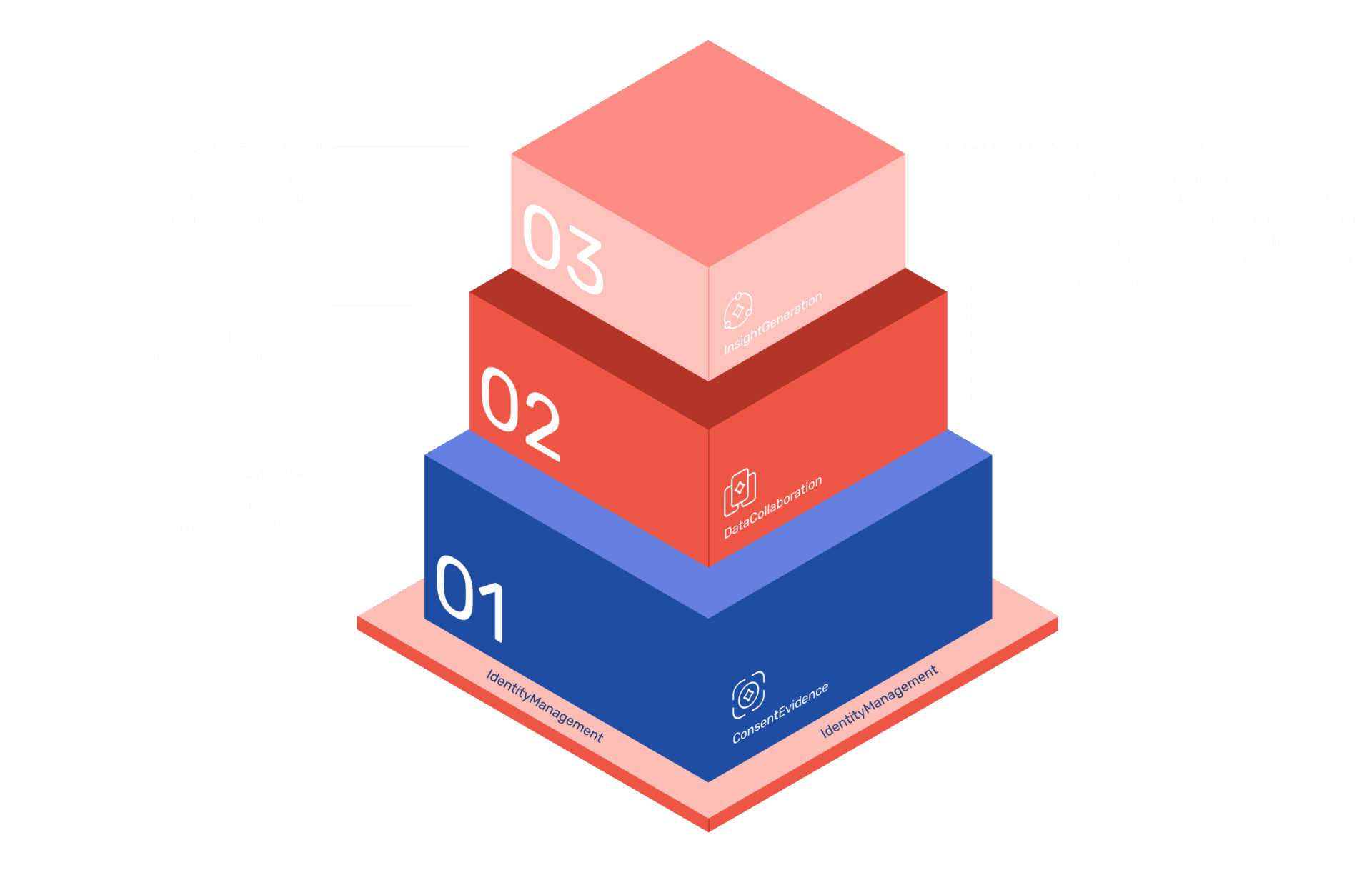
Each tool addresses a different stage of data use, but all operate within a shared governance and evidence model. Together, they enable public institutions to move from defensible consent, to governed data collaboration, to trusted insight generation — while retaining control, legitimacy, and auditability.
By generating verifiable evidence of consent and data use, the tools help governmental & public institutions meet regulatory expectations and demonstrate responsible data handling to regulators, partners and users.
Consent Evidence forms the foundation of the stack, creating a verifiable record of consent state from the point of integration onward. This evidentiary layer establishes the trust anchor on which all further data use depends.
Data Collaboration and Insight Generation are layered on top of this foundation. They operate only within the consent state and governance constraints defined below them, thus depending the guarantees provided by the lower layer.
System Principles
Progressive adoption by use case
Shared governance framework
Evidence-based, not trust-based
No centralisation of raw data
The product stack is delivered through three governance tools, each addressing a different stage of data use.
Governance Tool Layers in the DfG Stack
01. ConsentEvidence
FOUNDATION LAYER
Many governmental and public institutions already collect consent — but struggle to prove how it has been handled when scrutiny arises. Consent Evidence provides a verifiable, independent record of consent state changes across systems, from the point of integration onward.
Instead of relying on fragmented logs, internal claims, or after-the-fact explanations, Consent Evidence forms a foundational evidence layer that shows:
What consent existed
When it changed
What it applied to
This makes consent handling inspectable and defensible when questions arise — from regulators, partners, or the public — reducing regulatory and reputational risk.
Consent Evidence forms the foundation for Data Collaboration and Insight Generation, which rely on the same underlying consent records and governance guarantees.
Dependancy
Required foundation for Data Collaboration and Insight Generation
What you get
An independent evidentiary layer on top of existing consent systems
Cross-system visibility into how consent is handled, not just within a single CMS
Ongoing, go-forward evidence of consent handling in practice
A way to demonstrate responsible consent handling under regulatory or public scrutiny
02. DataCollaboration
COLLABORATION LAYER
Many governmental and public institutions want to collaborate around data, but are blocked by trust, liability, and governance risk once data crosses organisational boundaries. This is often worked around through bespoke contracts, manual controls, or avoided altogether — slowing partnerships, business development, and increasing risk.
Data Collaboration provides a governed, consent-based framework for working with data across governmental and public institutions. It operates within declared consent and governance conditions and generates verifiable records of data access and interaction, rather than relying on assurances alone.
By making collaboration inspectable and accountable in practice, Data Collaboration reduces governance and coordination friction and enables governmental and public institutions to realise value from data partnerships under clear, agreed rules.
Dependancy
Requires Consent Evidence to verify consent state and permitted use across participating governmental and public institutions.
What you get
A governed framework for sharing and combining data across governmental and public institutions
Collaboration that balances value creation with control, grounded in Consent Evidence and a neutral, citizen-centric governance model
Clear, inspectable records of who accessed which data, under what consent and conditions
A way to make data partnerships legitimate, defensible, and easier to manage over time
03. InsightGeneration
ANALYTICS LAYER
Governmental and public institutions want to develop new insights, better services, or expand capacity using sensitive or distributed data. But trust, consent, and governance expectations often constrain how analysis can be done. In practice, this leads to data being centralised, scope being limited, or analysis avoided altogether due to governance risk.
Insight Generation enables predefined, governed analytical workflows that operate within declared consent and governance conditions. It produces verifiable outputs and execution records without exposing raw data or bypassing consent.
This allows insight-driven work to move forward while maintaining accountability and confidence in how insights are generated — supporting innovation without eroding public trust.
Dependancy
Requires Data Collaboration and Consent Evidence to execute governed analysis within declared consent and governance constraints.
What you get
A governed way to generate insights under defined governance and declared consent constraints
Verifiable execution records showing how insights were produced, not just the results
An enablement layer for analytics, innovation, and insight development that operates within permitted use
The ability to work with complex or sensitive data while retaining accountability and auditability
Discuss your use case with us
Get in touch, and we’ll help you identify the adoption pattern that fits your use case.
Contact us

EHDS Implementation
Making the European Health Data Space Work
The vision of the European Health Data Space (EHDS) is clear: a future where citizens can access and control their health data across borders, where healthcare providers can deliver better care using trusted information, and where research and innovation can improve health outcomes across Europe.
Turning that vision into reality requires more than policy. It requires a neutral operational layer that enables data to be shared, analysed, and governed in practice.
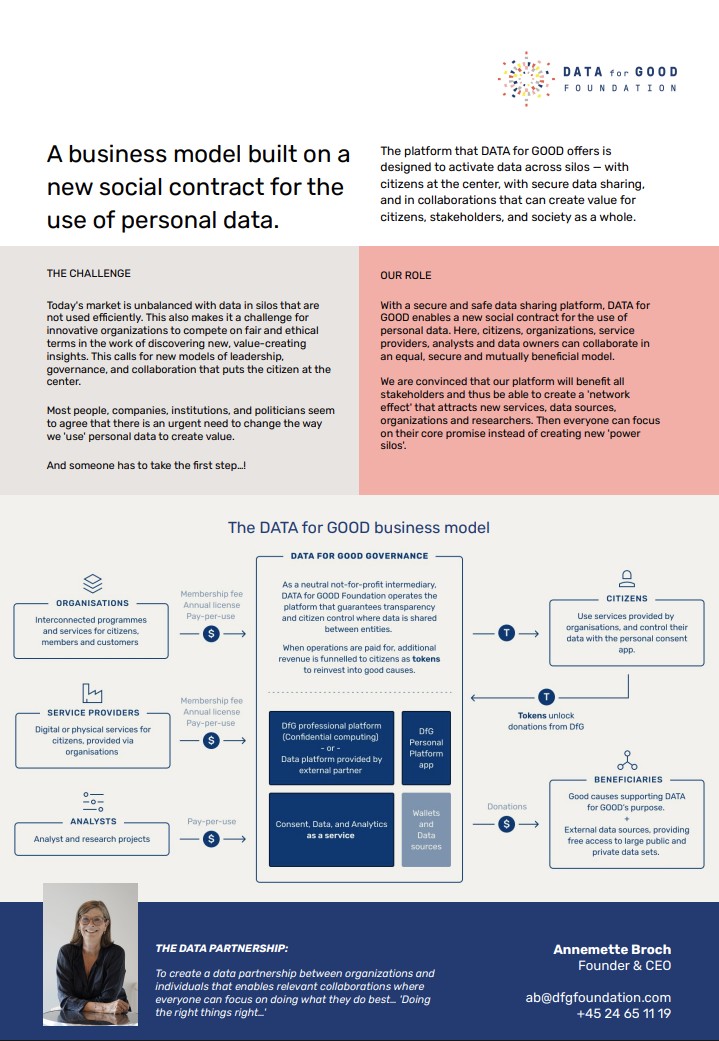
DATA for GOOD provides that operational layer. By combining consent-based data sharing, strong governance, and privacy-preserving technologies, the DATA for GOOD platform enables organisations to collaborate on health data securely while giving citizens transparency and control over how their data is used.
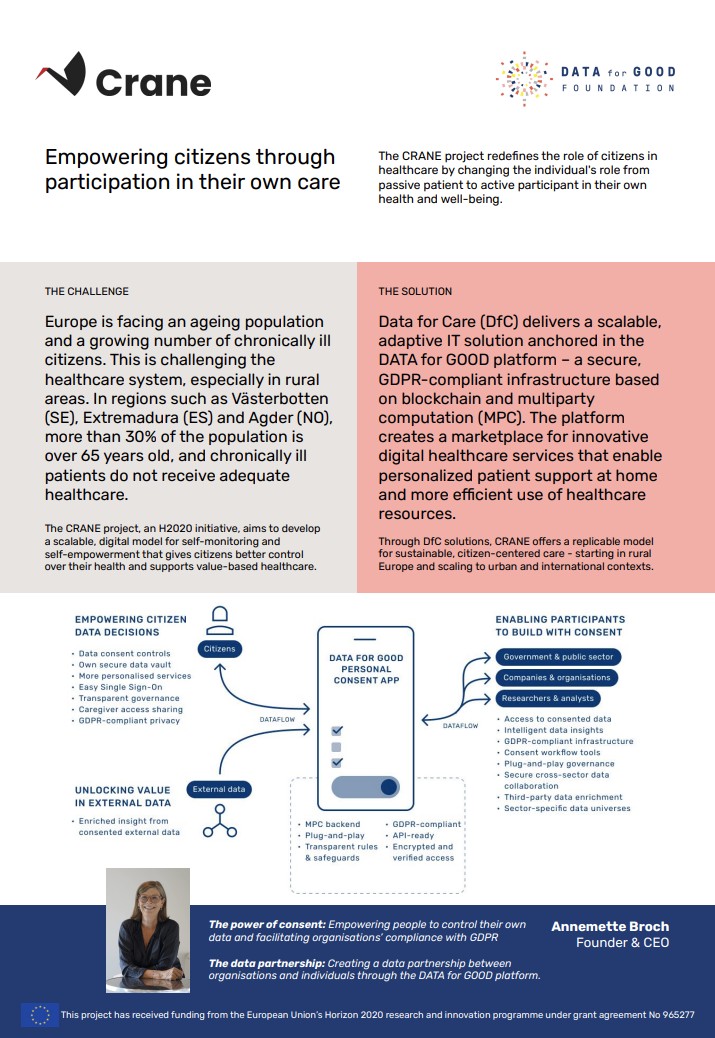
The approach has already been tested in real-world healthcare environments through the EU CRANE project, involving citizens, clinicians, and healthcare systems across Europe.
Enables trusted cross-organisational health data collaboration
Provides verifiable consent and transparency for citizens
Supports privacy-preserving analysis for research and innovation
Creates auditable evidence of how data is used across systems
Our Partners










DfG Projects & Results
Learn more about ongoing projects and how individuals, organisations, and society have benefited from the power of data.
Across health, social impact, and digital governance, DATA for GOOD initiatives demonstrate how trusted data sharing can improve outcomes, strengthen collaboration, and support evidence-based decision-making.
See all DfG projects
DfG Projects